The California Transparency in Supply Chains Act requires retailers and manufacturers doing business in California to disclose their efforts to eradicate slavery and human trafficking from their direct supply chains. Cascades supports the objectives of this Act, which are consistent with its values, Code of Ethics and Business Conduct, Commitment on Human Rights and responsible sourcing practices.
Verification
Cascades works with a recognized independent third-party service provider specialized in assessing supplier sustainability and responsible business practices. As part of its supplier due diligence process, and to ensure that it is working with organizations that share its values and engage in sustainable and responsible practices, Cascades regularly assesses a targeted number of suppliers in its direct supply chain based on risk-related criteria established by management and procurement teams.
The suppliers being assessed must complete a questionnaire covering a series of criteria grouped into four themes: environment, social practices, ethics and supply chain. The results of these assessments help Cascades identify potential risks, monitor supplier performance and determine whether additional engagement or corrective actions may be required.
Audits
Cascades does not represent that it routinely conducts audits of suppliers in response to elevated risk findings. However, high-risk or very high-risk findings under the detailed supplier assessment mentioned previously in the “Verification” section do lead to additional verifications.
Separately, certain Cascades facilities are assessed by independent external auditors, either at customers’ request or through Cascades’ proactive audit program. These audits assess Cascades facilities against applicable legal requirements and best practices relating to labour rights, health and safety, and human rights.
Supplier certifications
Cascades expects its suppliers to operate in compliance with all applicable laws and regulations in the jurisdictions where they conduct business, including laws relating to forced labour, human trafficking, slavery and child labour.
As part of Cascades’ procurement process and contractual relationships, suppliers are asked to acknowledge and adhere to the principles outlined in its Supplier Code of Conduct. These principles include respect for internationally recognized human rights and a prohibition against human trafficking, slavery, forced labour and child labour.
Accountability
Cascades’ employees and directors are always subject to its Code of Ethics and Business Conduct. Suppliers, agents, subcontractors and other business partners are separately subject to the expectations set out in the Supplier Code of Conduct, including applicable requirements concerning human rights, responsible sourcing and supply chain due diligence.
Employees who fail to comply with the requirements of the Code of Ethics and Business Conduct or related corporate policies may be subject to disciplinary measures, up to and including dismissal.
Cascades favours collaboration with suppliers that do not meet its expectations by inviting them to develop and implement an improvement action plan and by reassessing them. If a supplier shows no substantial improvement or demonstrated interest in human rights, Cascades may replace it. Moreover, Cascades reserves the right to terminate any business relationship with a supplier that fails to comply with international human rights and labour conventions and refuses to take steps to improve compliance.
Training
All Cascades employees must complete a mandatory training program that includes a component on the Code of Ethics and Business Conduct. Every employee, regardless of status or level of responsibility, must renew this component every three years.
In addition, all buyers on the strategic procurement team must complete mandatory training on risks related to failures to respect human rights in the supply chain. Renewed every five years, this training equips those buyers to identify, prevent and mitigate forced-labour and child-labour risks and to promote and uphold human rights with suppliers.
Last Updated: October 2026
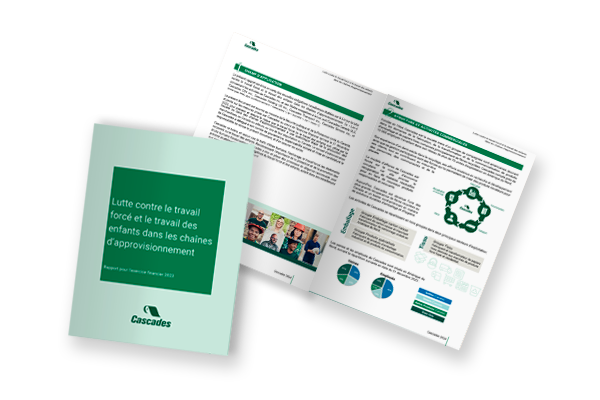
Report │ May 30, 2024
Fighting Against Forced Labour and Child Labour in Supply Chains Act
Report for fiscal year ended 2023
View the 2023 Report PDF - 0,6 Mo