Packaging has to perform on several fronts
Your packaging has to keep up with a high-speed production line, withstand transport, be easy to handle in the warehouse, meet regulatory requirements that vary from one region to the next, and drive your brand's commercial growth.
As environmental expectations tighten and extended producer responsibility (EPR) programs reshape cost structures, eco-design decisions have become business decisions.
Every change, whether a new format or a revised specification, can affect operational performance, recyclability, compliance costs, and your product's competitiveness.
Meeting all those constraints still isn't enough. A package that performs perfectly leaving the plant can still fail on the shelf.
- 82% of purchase decisions are made at the point of sale.
- 72% of consumers say packaging design directly influences their choice.
- 77% of consumers say recyclability is very or extremely important.
- 92% of consumers factor sustainability into their brand choices.
That's exactly why we brought together a dedicated innovation and design team: to turn these pressures into a competitive advantage. Our designers start from your business objectives: drawing attention at the point of sale, influencing the purchase decision, showcasing your environmental commitments, and ensuring production feasibility.
Every project also rests on strategic thinking about materials, processes, costs, and optimization opportunities, so the solutions we develop are as high-performing as they are eye-catching.

When to call on packaging innovation
Our designers step in early in your development, optimization, and go-to-market projects, while the structural decisions can still be influenced.
The most common situations include:
- A new feature, material, or technology to integrate into your packaging.
- A proven solution to transfer to an application where it has never been tested.
- A product specification change that throws your supply chain off balance.
- A packaging portfolio that has grown too broad, where rationalization could reduce costs.
- A promotional item or display to design for a launch or an event.
- Packaging that’s oversized or too heavy, where optimization could reduce material use and certain environmental impacts, and thus help better manage EPR-related costs.
"The best solutions rarely emerge in a vacuum. They take shape when customer knowledge, real-world constraints, and our design expertise come together."

Marine Gerard
Marketing Director, Science and Product Performance

Understanding your challenge before designing
Every project starts with a thorough understanding of the business challenge. A production line slowed down by a format, labour costs eating into margins, a product struggling to stand out from the competition on shelves—these signals don't always present themselves as packaging problems.
Our first job is to identify the root cause, then explore avenues that sometimes go beyond the mandate as it was originally framed.
Packaging innovation guided by your business constraints
An appealing concept that jams your automatic deloader, collapses when stacked, or adds cost per unit will never see the light of day. Every project therefore addresses the following all at once:
| Dimension | What we validate |
|---|---|
| Mechanical performance | Compression resistance, moisture resistance, protection all the way to the consumer |
| Your operations | Compatibility with your current equipment, your line speeds, no costly modifications |
| Your logistics | Dimensions, palletization, transportation, and storage optimization |
| Real-world use | Opening, handling, potential second life for the container |
| Resources | Amount of material, material selection, end of life, in line with our eco-design principles |
| Your brand | Shelf visibility, print quality, consistency with your positioning |
These criteria often pull in opposite directions. Lightweighting a structure improves the material footprint, but can weaken the box. Optimizing palletization may call for a format with less shelf appeal.
Our job is to inform your decisions with precise data and a holistic approach. Depending on the case, we draw on a range of analyses, including life cycle assessments (LCA), technical performance evaluations, and technical recyclability assessments. These enable us to compare several design scenarios and bring the trade-offs of each option to light on an objective basis.
A fiber-based packaging solution designed to optimize the supply chain
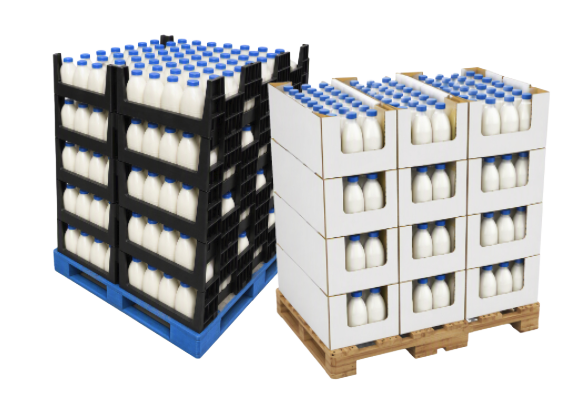
A dairy processor’s challenge was replacing a returnable plastic tray while maintaining a high capacity of 360 bottles per pallet and reliable performance in refrigerated environments.
Our designers developed a corrugated packaging solution built for those constraints. The new concept increases product shipping capacity by 20%. On top of withstanding refrigerated conditions, it optimizes the entire supply chain.
Discover our shipping and handling solutions

Prototyping and testing before market launch
An idea remains an idea until it has been manufactured and put to the test. Every avenue we retain becomes a physical prototype that is handled, stacked, and loaded. Our solutions can be put through a full battery of tests, either in real-world conditions or at our Research and Development Centre, equipped with advanced testing facilities to validate the mechanical, logistical, and environmental performance of packaging.
- Compression: behaviour under load, in stacks, and on pallets.
- Vibration: simulation of real-world road transport conditions.
- Drop: impact resistance during handling.
- Environmental chamber: resistance to humidity and temperature variations.
- Real-world trials, at your facility or in an independent laboratory, when shelf life or line speed are at stake.
For your procurement and operations teams, this stage turns a proposal into an informed decision. It reduces implementation risk, avoids surprises during production, and shortens the time between concept validation and first order.
Improving recyclability without compromising performance
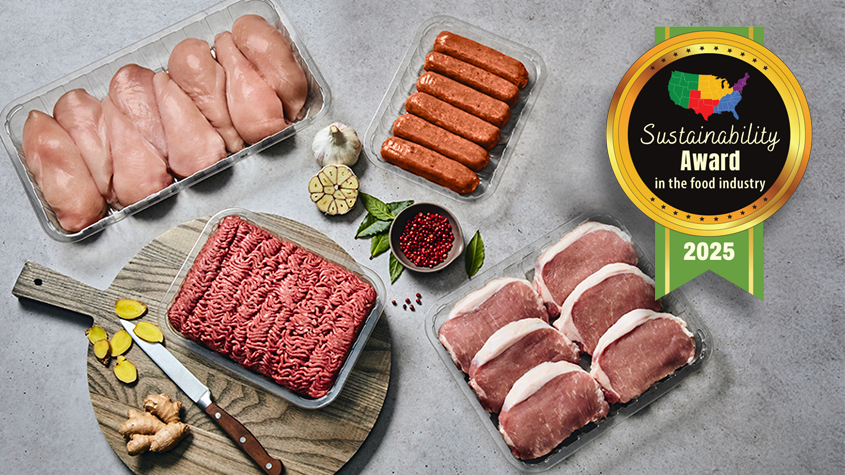
A major Canadian retailer wanted to replace the virgin expanded polystyrene in its fresh meat packaging to improve recyclability. The RPET rolled edge tray , made from 100% recycled material, passed independent laboratory testing before any implementation.
It keeps meat fresh for up to two days longer than flat-bottom models6 and runs on existing high-speed lines with no equipment modifications. More than 150 million units have been produced since.7 The project received the 2025 Sustainability Award from The Shelby Report.
Read the full case study
A chain of expertise behind every project
Our designers never work alone. Depending on the nature of your challenge, they collaborate with our paper, printing, and sustainability experts, plant technical teams, market analysts and eco-design specialists.
This multidisciplinary approach makes it possible to reconcile commercial, operational, and environmental objectives from the earliest phases of development.
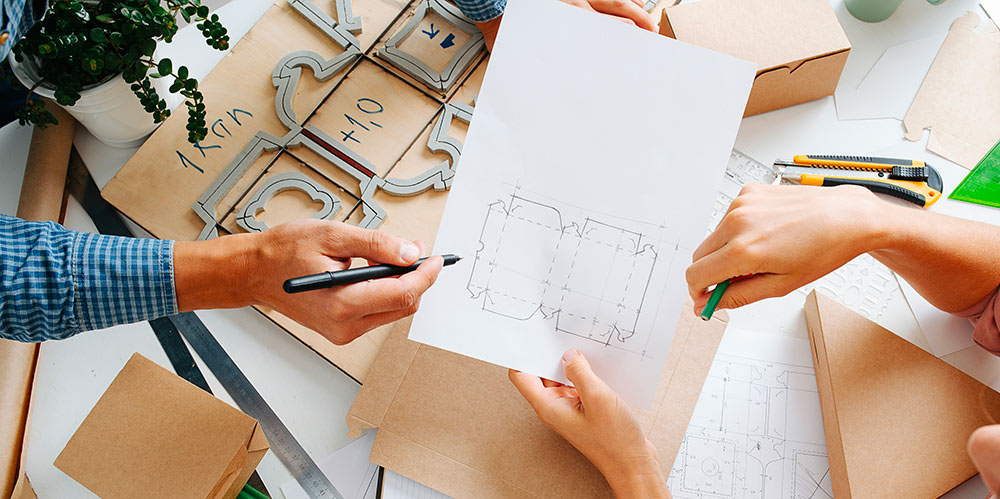
It's this continuity—from raw materials all the way to shelves—that separates a packaging supplier from a true partner. It is supported by more than 60 years of expertise in fibre, converting, and recovery.
Have a packaging challenge that hasn't found its solution yet?
Whether you're looking to reduce logistics costs, successfully transition to a new material, or stand out on shelves, our design experts can support you right from the concept phase. Let's talk.
1 Forbes, In-Store Branding and the Psychology of Shopping, March 2024
2 Forbes, In-Store Branding and the Psychology of Shopping, March 2024
3 McKinsey, Sustainable packaging: 2025 Global Consumers View (% US Consumers) 2025 Two Sides Trend Tracker Report, Sept. 2025
4 McKinsey, Sustainable packaging: 2025 Global Consumers View (% US Consumers) 2025 Two Sides Trend Tracker Report, Sept. 2025
5 Based on a palletization capacity comparison: 432 bottles per pallet using Cascades’ solution compared to 360 bottles per pallet using the previous solution.
6 Itega report, Validation of rPET Tray Performance for Fresh Beef Protein Packaging, April 2025
Compared to Cascades’ flat-bottom rPETE models.
7 Annualized volume estimate based on internal data provided by the Canadian food retailer (2025)