Regulations are getting stricter and consumers are increasingly expecting more responsible packaging. For the food industry, the transition from expanded polystyrene trays—used for proteins and produce—to recyclable alternatives has become a concrete issue in terms of compliance, operational performance, and brand positioning.
This practical guide was designed to guide you through this transition. It helps you determine what you need to analyze, validate, and confirm every step of the way to make informed choices adapted to your reality.
Clarify your starting point
Before comparing materials or testing new trays, you need to understand your current situation. This analysis provides a clear framework for future decisions.
To get started, take stock of your reality and ask yourself the following questions:
- What current or upcoming regulations apply to our markets?
- What is the potential impact if keep using polystyrene in the short or medium term?
- What are our internal sustainable development priorities?
- What expectations do our customers/partners have?
These answers are the foundation for the entire transition.
Analyze and compare materials
Choosing the right material is one of the most important decisions in this process. It must meet environmental requirements, as well as operational and business goals.
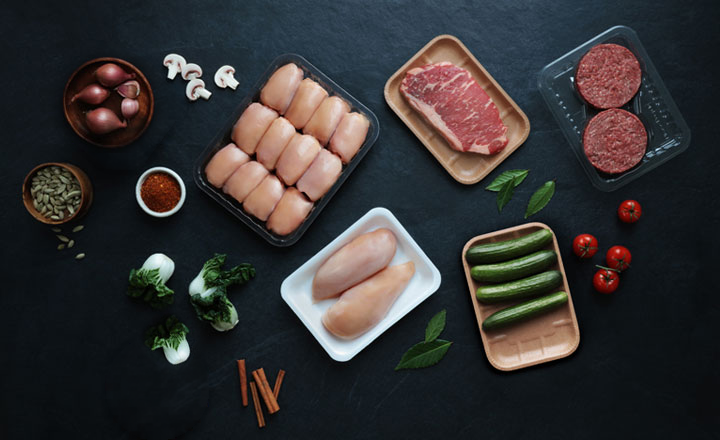
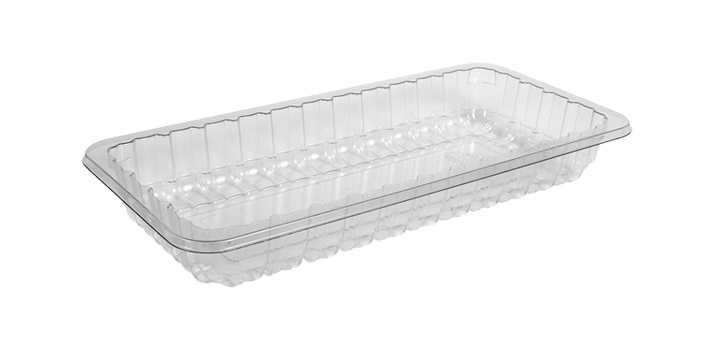
Trays made from 100% recycled cardboard fibres or recycled PETE (rPETE – polyethylene terephthalate) are relevant alternatives to polystyrene. Recycled materials help reduce landfilling and support the circular economy.
Objective data, including life cycle assessment, is essential to making the right decision. At this point, ask yourself the following questions:
1
Is the material made from recycled materials?
2
What is its environmental impact throughout its life cycle?
3
Is it recyclable in our markets’ existing infrastructure?
4
Is it aligned with our sustainable development commitments and goals?
For example, life cycle assessments show that 100% rPETE trays reduce the impact on climate change by 34% compared to virgin polystyrene trays.1
Cardboard trays made from 100% recycled fibre reduce greenhouse gas emissions by 33%.2

Validate performance in your operational landscape
The packaging solution you choose must remain uncompromisingly effective in the field. This step is critical to ensuring a smooth transition that doesn’t impede product productivity or quality.
We recommended that you test the solutions you’re considering under real-world conditions and work closely with your suppliers to anticipate necessary adjustments.

Here are the key factors you should analyze and confirm:
- Are the trays as rigid as their polystyrene versions?
- How are they affected in humid environments?
- Is the food still being stored optimally?
- Are they compatible with automated high-speed production lines?
- Does their denesting speed meet your requirements?
- Are storage and stacking still effective?
- Are equipment modifications required?
According to tests carried out at the Cascades Research & Development Centre, design details like rolled edges, can also help prevent film tearing and reduce the risk of food loss and repackaging. These sometimes underestimated factors play a key role once in production.
Confirm regulatory compliance and certifications
Restrictions on polystyrene are evolving rapidly and vary across jurisdictions.3
Furthermore, certifications provide reliable benchmarks to assess the credibility and quality of your preferred solutions.
This includes checking for :
- Applicable and upcoming regulations, including municipal and state regulatory frameworks specific to your consumers’ territories.
- Compliance with standards and requirements set out by the Food Food and Drug Association and Health Canada.
- Recognized certifications, such as FSC® (Forest Stewardship Council®)for fibres from responsible sources.
- Compostability certifications, such as CMA (Compost Manufacturing Alliance), where applicable.
- How2Recycle® pre-qualification for clear recycling instructions for end consumers.
- The product’s place of manufacture, from SFQ-certified (Safe Food Quality) facilities.
Prepare communication and marketing
The transition to more sustainable packaging is also an opportunity to strengthen your brand positioning. Consumers are placing increasing importance on packaging that reduces its environmental impact through a rigorous eco-design process. This information directly influences their purchasing decisions.
To take full advantage of this transition, you need to consider how it will be communicated.
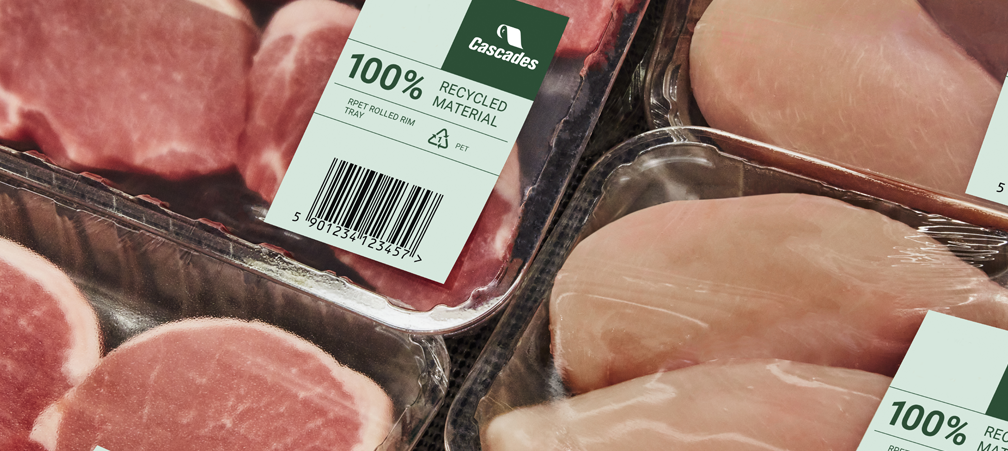
- How do we explain this change to our customers in a clear and transparent way?
- What environmental claims are relevant and credible for our market?
- How do you ensure that our messaging complies with local greenwashing laws?
- How do we ensure consistency between our messaging and packaging choices?
- Comment assurer la cohérence entre notre discours et nos choix d’emballage?
Honest and structured communication can turn a business choice into a true competitive edge.

Mobilize teams and ensure a smooth transition
Changing packaging also involves those who handle, process and market it. Informing and engaging teams from the outset fosters buy-in and facilitates implementation.
Explain why polystyrene is being replaced, what the new solutions’ tangible benefits are, and how each of them contributes to this process. When done collectively, the transition becomes even more effective and credible.
Move forward with confidence
Moving from expanded polystyrene to more environmentally friendly alternatives require a structured approach based on analysis, validation and collaboration. By asking yourself the right questions every step of the way, you empower yourself to make choices consistent with your operational constraints and commitments.
Counting on a seasoned partner is a real asset when the time comes to turn this analysis into concrete action. At Cascades, we believe that eco-designed packaging should support your operations, not impede them. We collaborate pragmatically with the businesses we guide throughout this transition.
1 CASCADES Life Cycle Assessment (LCA), AGECO Group; February 2023.
Notre barquette en rPETE 100 % recyclé de grade processeur en comparaison à une barquette vierge de la concurrence disponible sur le marché.
2 CASCADES Life Cycle Assessment (LCA), AGECO Group; February 2023.
Notre barquette en carton 38 points avec une barrière à l’humidité en comparaison à une barquette en polystyrène vierge de la concurrence disponible sur le marché.
3 Source pour règlementation sur le polystyrène : FPI (Foodservice Packaging Institute), Dec. 2025.
Articles
Articles
Articles

Articles
Articles